

How Malt Barley Vodka is Made — Grain to Glass at Tayport Distillery
Most vodka starts with wheat or potato. Ours starts with malt barley from Crisp Malt — grown by named farmers across Fife and Angus and malted by Crisp Malt themselves. It's an unusual choice for vodka, and a deliberate one.
Below is the complete process: mashing, fermentation, and distillation. We've filmed each stage in the distillery so you can see exactly what happens between a sack of grain and the bottle on your shelf.
Why malt barley — and why does it matter for vodka?
Malt barley is the traditional base for Scotch whisky. It's rarely used for vodka, mainly because it's more expensive and more demanding to work with than wheat. We use it anyway, because of what it brings to the final spirit.
When you distil malt barley properly, you get a vodka with body — a natural creaminess, a hint of biscuit, a faint cocoa sweetness that doesn't come from flavourings or additives. It comes from the grain itself. That character is why our Malt Barley Vodka won an IWSC Gold Outstanding — one of the highest scores in the competition — and why it was named best craft distillery vodka in the world at the World Vodka Masters in 2021.
We source our barley from Crisp Malt, who have supplied us from the start. Every batch is traceable to the growers they work with across Fife and Angus. That's not something a supermarket own-label vodka can say.
Part 1: Mashing — turning grain into sugar
Before fermentation can happen, the starches locked inside the barley need to be converted into fermentable sugars. That's what mashing does.
The process starts the night before. We preheat the mash tun with hot water to stabilise the temperature — barley is sensitive to heat, and consistency matters. The target is 69°C at the point the grain meets the water, a temperature precise enough that being a fraction of a degree out can result in less yield. This temperature is called the the strike temperature. The temperature of the water mashing in starts at 69°C and when all the barley and water is in our mash tun this temperature should drop down to around 64-65°C (the rest temperature).
Loading the grain
Each batch uses sacks of malt barley that we load into a grain bucket at the base of the mash tun. An auger pulls the grain upward and mixes it with the hot water as it enters — this is called mashing in. The rake inside the tun keeps everything moving, wetting every grain evenly so there are no dry patches that would waste the batch.
Once the tun is full, we leave it for 45 minutes. The heat and the natural enzymes in the malted barley do the work — breaking down the starches and releasing the sugars we need. You are looking for a resting temperature of around 64 - 65°C. The rest temperature is holding the crushed barley and water at specific, targeted temperatures to activate enzymes that convert starches into fermentable sugars. If you are too high or too low on this temperature it will affect the outcome of your vodka in terms of taste and yield.
The vorlauf
After the rest, we run what's called a vorlauf. The liquid at the bottom of the tun — cloudy with grain sediment — gets recirculated back to the top and allowed to filter down through the grain bed. You can watch it change colour over about 20 minutes, going from a pale straw to a deeper amber as the sugars and flavour compounds are extracted. When the colour is right, we know it's ready to drain.
The sparge
We drain the first water — now sweet with dissolved sugars, and called wort — into the fermentation vessel. Then we add a second water, the sparge, at a higher temperature than the first. This rinses through the grain bed and picks up the residual sugars that the first water didn't fully extract. Every gram of sugar that makes it into the fermentor is alcohol that ends up in the final vodka.
Part 2: Fermentation — turning sugar into alcohol
The wort from the mash tun is hot — around 60–65°C when it leaves. Yeast can't survive at that temperature, so before we can start fermentation, we need to cool the wort to around 28°C.
The heat exchanger
We use a plate heat exchanger — 80 stainless plates that the hot wort flows through on one side while cold water flows through on the other. The two liquids never meet, but the temperature transfers through the plates. By the time the wort reaches the fermentation vessel, it's at the right temperature for the yeast to activate.
Adding the yeast
We use Safspirit D53, a distiller's yeast, along with a small amount of Servomyces — a yeast nutrient that helps the fermentation get going quickly and run cleanly. We mix both into a small amount of wort first, then pump it into the 2,000-litre vessel.
Fermentation takes four to five days. The yeast works through the sugars steadily, converting them to alcohol. We let it go until it's fully finished — no shortcuts — because every extra day increases the yield and gives us a cleaner base to work with in the still.
When fermentation is complete, the liquid — now called the wash — is sitting at around 8 to 8.5% alcohol. It goes to the still.
Part 3: Distillation — from 8% wash to 96% spirit
We distil on an iStill — a modern column still that gives us precise control over every variable in the distillation process. We were the 33rd distillery in the world to install one, eight years ago, and the technology is still ahead of most of what's available.
The pot run
The first distillation is called the pot run or stripping run. We load the still with 500 litres of wash and heat it to boiling. The alcohol vapours rise up through the column, where they're condensed and re-distilled multiple times through a process called reflux. What comes out the other end is around 30–35% alcohol — not yet vodka, but a clean, concentrated spirit called low wines.
Fores, Heads, hearts, and tails
The second distillation — the spirit run — is where the vodka is made. Not all of what comes off the still is usable. The first part to distil, called the fores and the heads, contains acetone and other compounds you absolutely don't want. The last part, the tails, has the wrong flavour profile. The good vodka is in the middle: the hearts.
On the iStill, we dial in our recipe on the PLC controller — a combination of heat, cooling, and air pressure management that allows us to cut precisely at the point where the hearts begin and end. There's no guesswork. The equipment separates what we want from what we don't, and we collect only the fraction that meets the standard.
What comes off the still at that point is 96% alcohol — clear, clean, and carrying that characteristic malt barley sweetness that the judges at the IWSC described as "comforting cacao nibs enveloped in rich chocolate loaf and laced with malted spiced vanilla."
The result
The vodka that comes off the still goes through a final quality check before it's bottled. The grain it started as — Crisp Malt barley from farms in Fife and Angus — is long gone, but what it left behind is still there in the glass: a faint warmth, a biscuity softness, and a finish that's clean without being flat.
That's what the IWSC Gold Outstanding judges called "smooth and luxurious — a gorgeously unctuous textured sweet nectar." And it's what the World Vodka Masters panel described as "very aromatic, creamy and smooth with superbly integrated alcohol." No additives. No flavourings. Just malt barley, water, and a process we've spent eight years refining.
Try it for yourself
If you'd like to taste what a malt barley vodka actually tastes like — as opposed to reading about it — our Malt Barley Vodka is available directly from the distillery.
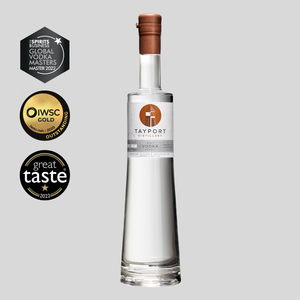
Award-Winning Malt Barley Vodka
Faqs
How is vodka made?
Vodka is made by fermenting a sugar source — most commonly wheat, potato, or in our case malt barley — with yeast to produce an alcoholic liquid called a wash, then distilling that wash to concentrate and purify the alcohol. At Tayport Distillery, we mash malted barley to extract fermentable sugars, ferment the wort for six to seven days, then distil twice on a column still to reach 96% alcohol, cutting precisely at the hearts to keep only the cleanest spirit.
What makes malt barley vodka different from wheat vodka?
Wheat vodka tends to be neutral and light. Malt barley vodka — because it starts from the same base as Scotch whisky — retains more of the grain's natural character after distillation: a creaminess, a slight biscuit note, and a warmth on the finish. Our version was described by IWSC judges as having "comforting cacao nibs and malted spiced vanilla" — qualities that come entirely from the grain, not from additives.
Where does Tayport Distillery's malt barley come from?
We use malt barley from Crisp Malt, sourced from their network of growers across Fife, Angus and more farms mainly on the East side of Scotland. The exact malted barley we use is called Scottish pot Still Malt and it is perfect for distilling. Crisp Malt have supplied us from the beginning. The barley is malted — a process that activates the enzymes needed to convert starches to sugars — before it reaches us.
How long does it take to make Tayport Malt Barley Vodka?
From mashing to the end of fermentation is around eight days. Distillation takes a further day. In total, from a sack of barley to a finished spirit, the process takes around ten days per batch.
What awards has Tayport Malt Barley Vodka won?
Tayport Malt Barley Vodka has won an IWSC Gold Outstanding (the highest score bracket at the International Wine and Spirit Competition), a World Vodka Masters award for best craft distillery vodka in the world (2021), a 1-star Great Taste Award, and a Farm Shop & Deli Gold Medal. It has also been featured in Forbes's World's Top 10 Vodkas.
